
Self-Care: A Personalized Path to Wellness

Self-care is increasingly recognized as a foundation for wellbeing—not just a luxury, but a vital part of maintaining physical, emotional, and social health (Ayala et al., 2021; World Health Organization, 2022). Self-Care is about everyday actions that support your unique needs and happiness (Mills et al., 2018).

What self-care looks like varies for everyone. For some, it’s sharing meals, spending time outdoors, listening to music, or engaging in spiritual or community traditions (Moodley et al., 2020; Sue & Sue, 2022). Research shows these activities can help reduce stress, support emotional health, and strengthen social connection (Ayala et al., 2021; Mills et al., 2018).

Caring for your body—by eating nutritious foods, getting enough sleep, and staying active—can boost your energy and physical health (Ayala et al., 2021; Slade et al., 2017). Emotional self-care, such as journaling, talking with a friend, or practicing mindfulness, is linked to better stress management and emotional regulation (Mills et al., 2018; Suleiman-Martos et al., 2020)

Self-care can also improve relationships and help you focus better at work and home (Ayala et al., 2021; Sorenson et al., 2016). The most effective habits are those that fit your values, culture, and personal circumstances (Moodley et al., 2020). 

If you’re ready to build self-care routines that truly work for you, reaching out for support from a mental health professional can help you get started. Our team is here to provide effective, evidence-based solutions to help you in building a secure, resilient self, and help strengthen your relationships. 

About the Author:

Dr. Shasha Oosthuizen, C.Psych. (Supervised Practice), is a psychologist in Clinical and Counselling Psychology at the Centre for Interpersonal Relationships, working under the supervision of Dr. Lila Hakim, C.Psych. Her doctorate dissertation focused on self-care. She provides therapy to adult individuals and couples for a wide range of concerns, using various treatment modalities tailored to each client’s unique goals and needs. She welcomes clients from all backgrounds and is committed to offering a nonjudgmental, compassionate, and authentic therapeutic space. Learn more: https://cfir.ca/about/toronto-team/shasha-oosthuizen/

References

Ayala, G. X., et al. (2021). Self-care as a health-promoting behavior: A systematic review. American Journal of Health Promotion, 35 (2), 263-275.

Mills, J., Wand, T., & Fraser, J. A. (2018). Self-care in mental health nursing: A meta-synthesis of qualitative studies. International Journal of Mental Health       Nursing, 27(2), 662-677.

Moodley, R., Gielen, U. P., & Wu, R. (2020). Global Perspectives in Multicultural Counselling: A Handbook for the 21st Century. Routledge.

Slade, S. C., et al. (2017). Consensus on exercise reporting template (CERT): Explanation and elaboration statement.  British Journal of Sports Medicine, 50 (23), 1428-1437.

Sorenson, C., Bolick, B., Wright, K., & Hamilton, R. (2016). Understanding compassion fatigue in healthcare providers: A review of current literature. Journal    of Nursing Scholarship, 48 (5), 456-465.

Sue, D. W., & Sue, D. (2022). Counselling the Culturally Diverse: Theory and Practice (9th ed.) Wiley. 

Suleiman-Martos, N., et al. (2020). The effect of mindfulness training on burnout syndrome in nursing: A systematic review and meta-analysis. Journal of        Advanced Nursing, 76 (5), 1124-1140.

World Health Organization. (2022). Self-care interventions for health. https://www.who.int/news-room/fact-sheets/detail/self-care-health-interventions
There’s just never enough time! – Recognizing the Signals of Burnout and Taking Action

Burnout is a condition that often begins subtly, like a small flicker of discomfort in our daily professional lives. It canmanifest as fatigue that lingers, low motivation and productivity with work duties or a growing sense of frustration, stress and dissatisfaction at one’s job (WHO, 2019; Maslach, Christina & Leiter, 2016). These signals are not always immediately recognized as signs of burnout, but they can indicate that something is out of balance in our mental, emotional, or physical well-being.

In times of being busy with many demands of life, the tendency is to ignore these signals because we’re still getting things done at work and juggling our personal commitments. So it can be easier to push through with the belief that we can handle it or that things will get better and we “just need to make it through this month.” But ignoring these cues can often lead to more intense feelings of exhaustion, irritability, stress, low mood and decreased motivation (Salvagioni, Melanda, Mesas et. al, 2017).

When noticing these symptoms, this can be a really good opportunity to reassess and engage with practical strategies to feel better and regain balance.

  1. Recognizing the need for rest. This doesn’t just mean getting better sleep, but also taking mental breaks throughout the day like creating 15 minute breaks in our calendar, or periodically scheduling a day or afternoon off.
  2. Awareness of boundaries. Sometimes we may push ourselves to meet the demands of others at the expense of our own well-being. Start by identifying where you can say “no” or delegate tasks. This may mean having difficult conversationsbut protecting your time and energy is key.
  3.  Add self-care into your routine. This might include engaging in a small hobby, going for a walk, reading, or practicing mindfulness for a few minutes each day. These things may not seem ‘productive’ but they matter and can help to ground us and reduce stress.
  4. Seek supportTalk to a therapist, a trusted friend/family member, or a mentor. They can possibly provide valuable guidance and compassion to alleviate the sense of self pressure and isolation that can occur when struggling.

Burnout is not a sign of weakness, it’s a signal that we need to prioritize our physical, mental and emotional self. The willingness to reflect, evaluate and make small changes to our day-to-day can go a long way in helping regain balance and ultimately improve our overall well-being.

Dr. Jamal Lake, Psy.D, C.Psych. is a Clinical Psychologist at the Centre for Interpersonal Relationships. Using a calm, compassionate yet engaging approach, Dr. Lake provides psychotherapy to adults for a range of challenges including concerns related to anxiety, stress/burnout, depression, ADHD and relationship difficulties. He primarily works from a Cognitive Behavioural Therapy (CBT) lens but integrates other evidence-based therapies such as Acceptance and Commitment Therapy (ACT), Dialectical Behavioural Therapy (DBT) and mindfulness-based techniques into his treatment.

References

Maslach, Christina & Leiter (2016). “Understanding the Burnout Experience: Recent Research and Its Implications for Psychiatry.” World Psychiatry15, no. 2: 103–11.

Salvagioni DAJ, Melanda FN, Mesas AE, González AD, Gabani FL,  Andrade SM (2017). “Physical, Psychological and Occupational Consequences of Job Burnout: A Systematic Review of Prospective Studies.” PLOS ONE 12(10): e0185781. https://doi.org/10.1371/journal.pone.0185781

World Health Organization (2019). Burnout an “occupational phenomenon”: International Classification of Diseases. Retrieved December 18, 2024, from: https://www.who.int/news/item/28-05-2019-burn-out-an-occupational-phenomenon-international-classification-of-diseases.

Pause with Purpose: Unraveling the Secret Between Rest and Laziness

As we have now passed the month of January, the initial shimmer of New Year’s resolutions might be starting to fade. It’s the perfect time to reflect on the delicate balance between rest and laziness – a balance crucial for our productivity and well-being.

Rest is not merely the absence of work; it’s an intentional practice, a vital component of a balanced life. Unlike the often guilt-tinged idleness labelled “laziness,” intentional rest rejuvenates the mind, body, and soul, fuelling our next burst of activity. It’s choosing to pause, breathe, and engage in activities that restore our energy. On the other hand, laziness can sneak up on us, a passive state where time slips through our fingers unproductively, leaving us oddly unrefreshed.

So, how do we cultivate intentional rest and keep the shadow of laziness at bay? The answer lies in mindfulness and deliberate choice. Set aside time for activities that genuinely replenish you. Whether it’s a quiet walk, a meditative hour with a book, or a friendly games night, make sure these moments are marked with purpose. By consciously choosing how and when to rest, we honour our need for downtime without falling into the trap of aimless laziness.

Also, it’s essential to recognize the signs of burnout. It might be time to reassess your rest if you’re feeling uninspired or perpetually drained. Are you truly relaxing or just ‘crashing’? Intentional rest should leave you feeling revived and ready to embrace your tasks with renewed vigour.

In this dance of life, ensure each step – be it forward in action or sideways into rest – is taken with intention. Doing so creates a rhythm that sustains, nurtures, and propels us forward. Here’s to mastering the art of intentional rest, making every moment – active or still – a step towards a fulfilled and balanced life!

Laura Moore, MPsy., is an integrative therapist at the Centre For Interpersonal Relationships (CFIR) in Toronto under the supervision of Dr. Lila Z. Hakim, C. Psych. Laura provides psychological services to adults and couples experiencing a wide range of concerns. Laura has a particular interest and expertise in relationship distress, with an emphasis on interpersonal and couple relationship functioning. Laura has helped countless individuals navigate issues related to intimacy, fertility, sex, infidelity, separation and divorce. Additionally, her past research focuses on cultivating spousal attunement following traumatic experiences.

Physical vs. Emotional Hunger: How to Differentiate Between the Two?

Recognizing our hunger signals is an essential ability to ensure we are fueling our bodies properly. Without food energy, it isn’t easy to function cognitively, physically, socially, or emotionally. But have you ever noticed a difference between your physical and emotional hunger? 

Physical hunger is defined as a feeling of discomfort caused by a lack of food. Typical cues for this type of hunger include stomach growling, headache, feeling faint or weak, loss of energy, and irritability. When we recognize this physical need and tend to it with food, we’re usually satisfied and relieved. 

Emotional hunger does not stem from a need to eat. It arises from an emotion that we are not giving enough attention to. It is a sense of emptiness, a feeling that something is missing, a craving for comfort. In other words, emotional hunger does not come from the stomach; it’s derived from an unmet emotional need. 

“Emotional hunger does not come from the stomach; it’s derived from an unmet emotional need.”

According to the American Psychological Association, there is a strong connection between negative emotions and food. More than 35% of adults reveal turning to food to cope with their feelings monthly, and more specifically, seeking high-calorie and high-fat foods during periods of stress. This behavioral cycle can lead to different difficulties, including feelings of guilt and shame, heightened anxiety and lower mood, body image concerns, and disordered eating behaviors.

Being able to distinguish our physical hunger from our emotional hunger is, therefore, a valuable skill. Here are some questions to ask yourself to help meet your real needs, whether physical or emotional.

“Did my hunger come suddenly?”

Have your hunger cues developed progressively, or did they appear spontaneously? If your hunger is emerging gradually, eating a snack or a meal will be helpful. However, if the urge to eat is sudden and you are craving specific comfort food, you may be experiencing emotions that need your attention. 

“Is my hunger located in my stomach or not?” 

If you are not experiencing physical signals of hunger (e.g., stomach growling, feeling sluggish, headache), it can be worthwhile to ask yourself how you feel and what you need right now. Is it possible that you are feeling stressed, sad, or simply bored? What would help to cope with these emotions?

“Why am I still hungry after a full meal?”

If your hunger is still present after a typically satisfying portion, it may be necessary to employ coping or self-care strategies to support your emotional needs. These can include reaching out to a friend, journaling, doing breathing exercises, moving your body, or doing an activity you enjoy.

Our hunger signals can inform us on how we are feeling and what we are needing, and it can be valuable to learn how to understand them better. If you need more support to cope with difficult emotions or are experiencing overwhelming body image concerns or problematic eating behaviors, professionals at CFIR can work collaboratively with you. 

Dr. Karine Côté, D.Psy., C.Psych. is a psychologist at the Centre for Interpersonal Relationships (CFIR). Dr. Côté provides psychological services to individual adults and couples experiencing a wide range of psychological and relationship difficulties related to mood and anxiety disorders, trauma, eating disorders, sleep disruptions, and interpersonal betrayal. She works from a humanistic approach and integrates therapeutic techniques from gestalt and object relations psychotherapies, emotion-focused therapy (EFT), and cognitive-behavioral therapy (CBT).

Defining Self-Boundaries – Types of Boundaries (Part 3)


This final post of the 3-part series on boundaries will provide you with definitions for different types of boundaries. It is important to know these differences; doing so allows you to self-appraise how you maintain your sense of self with others. Research mostly focuses on three general types of boundaries: rigid, diffuse, and flexible. 

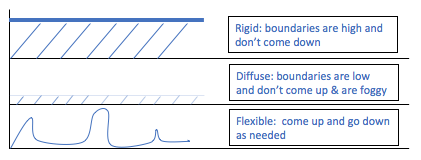
Let’s imagine boundaries as a wall you build up to protect yourself. They can be defined by the following:

Rigid – Walls are very high up, thick, and do not come down

Diffuse – Walls are very low, foggy, and confusing

Flexible: Walls are clear, go down and go up (to different levels) as needed.  

Rigid Boundaries: We might feel protected (especially if we have been through any type of trauma) when we set a rigid boundary without sharing more intimately about our feelings and needs. However, we are closed off to the other when we set a fixed limit — meaning that it’s difficult or nearly impossible for us to connect to others and to have others get close to us (emotionally, physically, etc.). This type of boundary makes it hard for others to understand our feelings and needs as little of ourselves is shared. We also may not be flexible enough to respond to the demands of others. 

Diffuse Boundaries: When we have diffuse boundaries, we might have difficulties communicating and/or understanding our boundaries (maybe from how you were raised, difficult experiences with limits). With diffuse boundaries, our borders are foggy, unclear, and are not defined. This particular boundary is difficult in relationships because you most likely tend to internalize other people’s emotions or let intrusive arrows (see the second blog in this 3-part series) right into your inner world. It often leads to feelings of resentment, frustration, shame, or sadness (etc.). 

Flexible Boundaries: When we have flexible boundaries, we can easily adapt to different situations in our relationships with others. Our boundaries are clear, healthy, and reflect our needs, desires, emotions, and values. We also maintain some openness to the other’s reality, thoughts, feelings, and needs. This creates a space in our relationships where it’s safe to discuss our thoughts, feelings, emotions, and desires and listen to the other and make adjustments to fulfill both parties. It also creates respect within your relationship and brings you closer together. Lastly, flexible boundaries prevent you from feeling overwhelmed or building up resentment, all while letting other people in, creating a secure attachment, and fulfilling your needs. 

We must establish a boundary to get to know who we are and what we need in our relationships to maintain a sense of safety and security and a sense of value and worth. Flexible boundaries might be ideal in relationships.

Mélodie Brown, B.A., is a therapist and completing a clinical psychology doctorate (D.Psy). At Centre for Interpersonal Relationships, she provides psychological services to adults and couples under the supervision of Dr. Dino Zuccarini, C.Psych. In the last year of her clinical psychology doctorate, Mélodie has completed all of her clinical training. She is in the process of finishing her thesis before receiving her licence as a clinical psychologist. 

Defining Self-Boundaries – When Is It Okay to Assert My Boundary?

After reading Part 1 and getting familiarized with boundaries and the difficulties we often face while setting them, you are probably wondering when or in what situations is it okay to set a limit in your interpersonal relationships?

The answer is: A boundary is set in our relationships with others to establish a felt sense of internal safety and security or maintain our sense of self-value and worth. We assert a boundary with another person to ensure we do not experience excessively high levels of negative emotional distress based on what others say, do, or express to us.

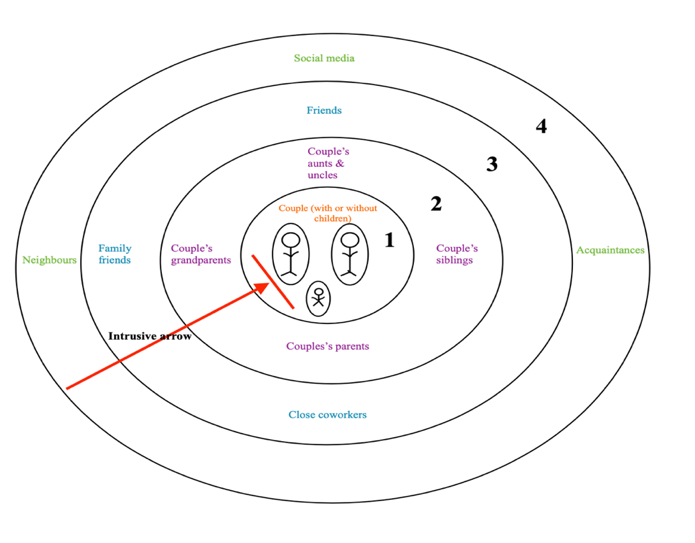
The model below has been devised to help you think about when it might be okay to set boundaries for yourself in everyday life. See model down below:

When you, your partner, or children receive an intrusive arrow (something that makes you feel bad—can be threats, insults, shaming, pressure, etc.) from anyone in circles 2, 3 & 4, it’s absolutely okay and healthy to put up a boundary to protect yourself, your partner or your child.

It’s also important to remember that in circle 1, each person is also a separate individual with their respective thoughts, opinions, feelings, emotions, wants, needs, values, and desires. Every individual can benefit from knowing this information as it’s the basis for setting a boundary. In terms of the diagram below, an individual has to establish a boundary with each member of their family and those relationships in the outer circle.

Remember that boundaries set with respect & authenticity are a way to protect yourself and your mental health. When you don’t set boundaries, you can be overwhelmed with stress and negative emotions that can lead to difficulties in your relationships. We become overwhelmed when we don’t listen to our feelings and bodies and set boundaries to protect ourselves from going into a space that is too much for us physically or psychologically. By setting boundaries, you also help yourself & the relationships around you grow. You and others learn more about who you are and how to relate to each other, and you are capable of being more invested and present for your romantic partners and other relationships.

Stay tuned for Part 3: Types of Boundaries.

Mélodie Brown, B.A., is a therapist and completing a clinical psychology doctorate (D.Psy). At Centre for Interpersonal Relationships, she provides psychological services to adults and couples under the supervision of Dr. Dino Zuccarini, C.Psych.. In the last year of her clinical psychology doctorate, Mélodie has completed all of her clinical training. She is in the process of finishing her thesis before receiving her license as a clinical psychologist.

Reconnecting with Yourself During Social Distancing

It’s been a strange time. There are daily news updates regarding the current pandemic; still, it’s uncertain how long we’ll be required to stay home. Some of us have found this period at home to be calming, while others have found it to be monotonous. The change of pace has left us with time to spend with (and learn more about) our selves. Here are a few things you may wish to explore:

Do Things You Enjoy: When life gets busy, we may start to neglect aspects of ourselves to make time for things that seem even more essential. During this time, allow yourself to reconnect with the things that bring you joy (e.g., art, music, writing, etc.). Reignite those passions and take note of how they affect your wellbeing. 

Unplug: The ongoing dissemination of news can become overwhelming. It is okay to allow yourself a chance to step away and take a breath. Instead of tending to something that may exacerbate feelings of anxiety and being out of control, shift your focus to what can be controlled-you. Do the things that bring you peace of mind (e.g., yoga, reading, cooking, etc.) 

Reminisce: It’s not uncommon to want to press ‘pause’ sometimes during fast-paced times. If you have some extra time now, reconnect with who you are, and how far you’ve come, whether it’s looking at old pictures or looking at mementos; allow yourself to look back on special memories. Reconnect with the forgotten parts of yourself and reflect on how they affect your wellbeing. If distressing feelings or thoughts arise, it may be an indication for you to reach out for support.

Re-Evaluate: With the opportunity to disconnect from ‘auto-piloting’ through life, we may start to evaluate our thoughts and feelings concerning our experiences in the present. Allow yourself to acknowledge this information. Sometimes, we may need to re-evaluate what is working and what is not working in our lives and how it’s affecting our wellbeing.

Social isolation can be a confusing and anxiety-provoking state to be in, but it may also teach you a lot about yourself. Taking the time to reflect on who we are, how far we’ve come, and where we would like to head in life can be a compelling experience. Therapists at Centre for Interpersonal Relationships can help you process different aspects of your identity during this time. We are currently offering virtual sessions that you can connect to from the safety and comfort of your home. Click here to learn more. 

Nereah Felix, B.A. is a registered psychotherapist (Qualifying) at Centre for Interpersonal Relationships (CFIR) in Ottawa and is under the supervision of Dr. Dino Zuccarini, C.Psych and Dr. Natalina Salmaso, C. Psych. The clients who come to see her are provided with an authentic, non-judgmental, safe, and supportive environment to share their experiences and improve their wellbeing. Nereah is currently enrolled in the Master of Arts in Counselling Psychology at the University of Ottawa.

Practicing Self-Compassion

Our emotions and thoughts can sometimes take over our minds in ways that are not helpful for us, and that can make us feel uncomfortable or distressed. Responding to situations and ourselves in kind and compassionate ways can allow us to feel safe and create a space to respond to our needs. Self-compassion can enable us to let go of self-criticism, and to respond to our critical thoughts in a supportive and caring manner. 

Next time you notice distressing thoughts and emotions arising in your mind, you may try the following to help yourself through in a self-compassionate way. Think of what you can say to yourself that is kind and soothing. Or, think of what you would say to a good friend when they are in distress and try applying that to yourself. Or, consider what a good friend might say to you during difficult times. For example, try these statements: “It’s okay for me to feel this way,” “I know this is difficult, but it will pass,” ; “I know it is scary, but I am here to keep you safe.” 

Don’t forget that you can comfort yourself physically, too. You might gently rub your chest or hold your hand. You may go for a nice walk, take a long bath, and change into comfortable clothes. It’s essential to stay kind and gentle towards yourself.

Dr. Khuraman Mamedova, C.Psych. is a psychologist in supervised practice at the Centre for Interpersonal Relationships (Toronto). She works with adults in psychotherapy, to support them to overcome difficulties related to mood and anxiety disorders, psychosis, trauma-related experiences, and relationships. She has completed research on the relationship between clients and therapists in psychotherapy.

Five Easy Tips to Improve Your Sleep Quality

by: Dr. Karine Côté, D.Psy., C.Psych. 

Do you have a hard time falling asleep? Do you wake up frequently during the night? Do you tend to wake up too early? Do you feel like your sleep is never really restful? You are definitely not alone! According to the American Academy of Sleep Medicine, about 30% of adults experience occasional insomnia, and 10% of the population suffers from chronic insomnia. 

The impacts of sleep difficulties on our psychological and physical functioning are diverse. They can include mood fluctuations, increased stress and irritability, problems with concentration and motivation, low energy and fatigue, an upset stomach, and muscle tension and headaches. Fortunately, there are strategies that can help improve your sleep quality. 

1. Practice sleep hygiene

Limit coffee, tea, and sugar intake after 3 PM. Eat your dinner and exercise at least two hours before your bedtime. Your bedroom should be comfortable and quiet, and try to limit looking at electronics, screens, and alarm clocks while in bed.

2. Implement a sleep routine

Maintaining a consistent routine throughout the week is vital. Ideally, your bedtime and wake-up time should be the same every day, even on weekends! 

3. Limit time spent in bed to sleeping

Time spent in bed should be reserved for sleeping (and romantic activities) only. Activities such as watching TV or reading in bed can contribute to your sleep difficulties. It is, therefore, more beneficial to engage in these activities in a comfortable space outside of your room and go to bed only when feeling sleepy. 

4. No napping

It is often tough to resist napping when we feel tired. However, to give you the best chance of sleeping during the night, eliminating any length of napping is essential.

5. Regulate your anxiety

Our sleep difficulties are often related to anxious thoughts that are hard to control. Writing them down before bedtime can help release anxious feelings, while also being reassured that your thoughts are not forgotten in the morning!

Consistently practicing these strategies will give you the best chance to overcome your sleep difficulties. However, if these tips do not work and insomnia persists, don’t be discouraged! Cognitive-behavioral therapy (CBT) offered in psychotherapy can help you regulate your sleep and provide beneficial effects that last well beyond the end of treatment. Don’t hesitate to reach out to Centre for Interpersonal Relationships for support – it is time to prioritize your sleep and regain restful nights! 

Dr. Karine Côté, D.Psy., C.Psych. is a psychologist at the Centre for Interpersonal Relationships (CFIR). Dr. Côté provides psychological services to individual adults and couples experiencing a wide range of psychological and relationship difficulties related to mood and anxiety disorders, trauma, eating disorders, sleep disruptions, and interpersonal betrayal. She works from a humanistic approach and integrates therapeutic techniques from gestalt and object relations psychotherapies, emotion-focused therapy (EFT), and cognitive-behavioral therapy (CBT).

Whole-Person Self-Care for the Holiday Period

by: Reesa Packard, M.A., Ph.D., R.P.

The dawn of a new holiday period is upon us once again; as the cool air sets in, the decorations are mounted, and typically, the to-do lists begin to grow… The holidays can be ripe with joy and celebration, but they can also be a time of stress. Being pulled out of our regular routines, eating more indulgent food, spending more money, being more immersed in the mixed experiences of family time, etc. can add up to create a holiday period that is harder than we hoped it would be. 

Whether there are specific stressors awaiting you this holiday period or you simply want to make the most of it, whole-person self-care can help you get there. So, what exactly is self-care? Self-care has its roots in 1950s medical communities, where it was learned that patients’ taking their own actions to care for themselves physically, spiritually, psychologically and emotionally was essential to their healing, health, and wellbeing. Now, decades later, the concept of self-care has been picked up by mainstream society. On social media, #selfcare now seems to depict a culture of luxurious consumerism and self-indulgence, but that is only part of its story. 

So, then what is whole-person self-care? While some versions of self-care can focus on a specific task that might help you feel better in one specific way, whole-person self-care is more like an attitude of overall self-reflection, and of building self-awareness, so that you can honour many different parts of yourself at once and care for your ‘entire self’. In this way, self-care is not only about taking a quick break or reveling in indulgences—self-care is about developing yourself, and your life, in a way that makes those breaks and indulgences less necessary to begin with. 

So, how can whole-person self-care help you this holiday season? You can use it as inspiration to get you thinking about questions like: “What is happening right now, how well is this working for me, and why?” “What is really important to me, out of all of this?” “How am I really doing?:” “How are my physical, spiritual, psychological and emotional parts doing right now?” “How are my relational, occupational, and financial parts doing right now?” “What do I want right now, what do I need right now, and how might those be different?”… These questions are the type that can lead you to become more self-aware, and as you build this self-awareness, you can have more clarity about the ways in which you might act to help yourself. 

Give yourself the best holiday gift this season, by connecting with yourself in the present! Try out some of the self-care strategies below: 

  • Physical: move your body or take rest, eat some nutrient-dense foods, quench your thirst, stretch your muscles, breathe deeply; 
  • Spiritual: immerse in a moment of silence, (re)discover some nature, attune deeply to yourself and others, contemplate some higher power or higher-order, seek experiences of awe and wonderment;
  • Psychological: build gratitude by naming what you are grateful for, emphasize relationships that fuel, and de-emphasize those that drain, ground yourself by scanning and taking in the details of the room and space around you; 
  • Emotional: practice feeling feelings as they arise, practice taking small breaks from feelings when they feel too intense, notice bodily sensations associated with feelings, try to fathom perspectives different than your own.

Professionals at CFIR can help you learn about and practice whole-person self-care. Contact us to inquire more and to begin or continue on your journey toward making yourself and your mental health a priority.

Reesa Packard is an Associate at CFIR. She has a doctoral degree from the Saint Paul School of Psychotherapy & Spirituality and works in private practice as a registered psychotherapist. She works with clients hoping to develop a more integrated sense of self as a means to well-being and meaningful, lasting transformation. Reesa is currently building a new service at CFIR called ‘The Integral Self’, which offers a place for clients to receive support and guidance in their advanced self-development, including spiritual and body-based growth. Reesa is also involved in the teaching and supervision of psychotherapists-in-training and advanced knowledge through research in her specialty fields.