
Defining Self-Boundaries – Types of Boundaries (Part 3)


This final post of the 3-part series on boundaries will provide you with definitions for different types of boundaries. It is important to know these differences; doing so allows you to self-appraise how you maintain your sense of self with others. Research mostly focuses on three general types of boundaries: rigid, diffuse, and flexible. 

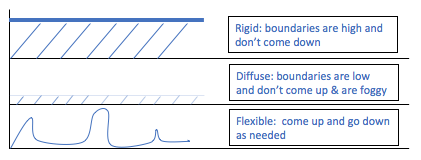
Let’s imagine boundaries as a wall you build up to protect yourself. They can be defined by the following:

Rigid – Walls are very high up, thick, and do not come down

Diffuse – Walls are very low, foggy, and confusing

Flexible: Walls are clear, go down and go up (to different levels) as needed.  

Rigid Boundaries: We might feel protected (especially if we have been through any type of trauma) when we set a rigid boundary without sharing more intimately about our feelings and needs. However, we are closed off to the other when we set a fixed limit — meaning that it’s difficult or nearly impossible for us to connect to others and to have others get close to us (emotionally, physically, etc.). This type of boundary makes it hard for others to understand our feelings and needs as little of ourselves is shared. We also may not be flexible enough to respond to the demands of others. 

Diffuse Boundaries: When we have diffuse boundaries, we might have difficulties communicating and/or understanding our boundaries (maybe from how you were raised, difficult experiences with limits). With diffuse boundaries, our borders are foggy, unclear, and are not defined. This particular boundary is difficult in relationships because you most likely tend to internalize other people’s emotions or let intrusive arrows (see the second blog in this 3-part series) right into your inner world. It often leads to feelings of resentment, frustration, shame, or sadness (etc.). 

Flexible Boundaries: When we have flexible boundaries, we can easily adapt to different situations in our relationships with others. Our boundaries are clear, healthy, and reflect our needs, desires, emotions, and values. We also maintain some openness to the other’s reality, thoughts, feelings, and needs. This creates a space in our relationships where it’s safe to discuss our thoughts, feelings, emotions, and desires and listen to the other and make adjustments to fulfill both parties. It also creates respect within your relationship and brings you closer together. Lastly, flexible boundaries prevent you from feeling overwhelmed or building up resentment, all while letting other people in, creating a secure attachment, and fulfilling your needs. 

We must establish a boundary to get to know who we are and what we need in our relationships to maintain a sense of safety and security and a sense of value and worth. Flexible boundaries might be ideal in relationships.

Mélodie Brown, B.A., is a therapist and completing a clinical psychology doctorate (D.Psy). At Centre for Interpersonal Relationships, she provides psychological services to adults and couples under the supervision of Dr. Dino Zuccarini, C.Psych. In the last year of her clinical psychology doctorate, Mélodie has completed all of her clinical training. She is in the process of finishing her thesis before receiving her licence as a clinical psychologist. 

Defining Self-Boundaries – When Is It Okay to Assert My Boundary?

After reading Part 1 and getting familiarized with boundaries and the difficulties we often face while setting them, you are probably wondering when or in what situations is it okay to set a limit in your interpersonal relationships?

The answer is: A boundary is set in our relationships with others to establish a felt sense of internal safety and security or maintain our sense of self-value and worth. We assert a boundary with another person to ensure we do not experience excessively high levels of negative emotional distress based on what others say, do, or express to us.

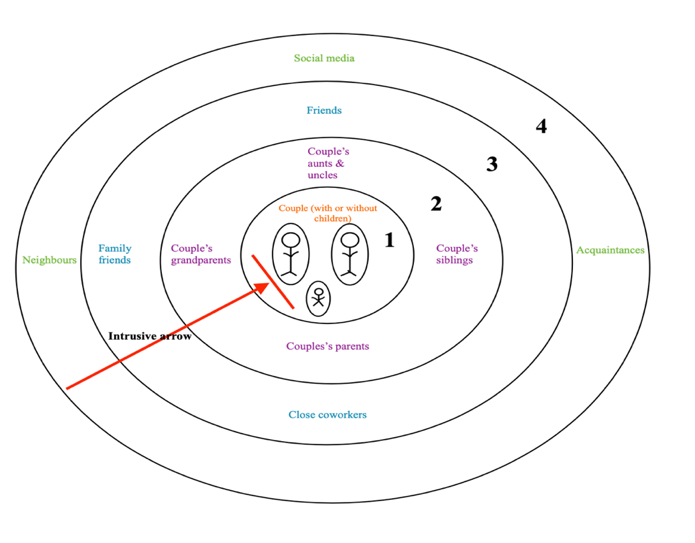
The model below has been devised to help you think about when it might be okay to set boundaries for yourself in everyday life. See model down below:

When you, your partner, or children receive an intrusive arrow (something that makes you feel bad—can be threats, insults, shaming, pressure, etc.) from anyone in circles 2, 3 & 4, it’s absolutely okay and healthy to put up a boundary to protect yourself, your partner or your child.

It’s also important to remember that in circle 1, each person is also a separate individual with their respective thoughts, opinions, feelings, emotions, wants, needs, values, and desires. Every individual can benefit from knowing this information as it’s the basis for setting a boundary. In terms of the diagram below, an individual has to establish a boundary with each member of their family and those relationships in the outer circle.

Remember that boundaries set with respect & authenticity are a way to protect yourself and your mental health. When you don’t set boundaries, you can be overwhelmed with stress and negative emotions that can lead to difficulties in your relationships. We become overwhelmed when we don’t listen to our feelings and bodies and set boundaries to protect ourselves from going into a space that is too much for us physically or psychologically. By setting boundaries, you also help yourself & the relationships around you grow. You and others learn more about who you are and how to relate to each other, and you are capable of being more invested and present for your romantic partners and other relationships.

Stay tuned for Part 3: Types of Boundaries.

Mélodie Brown, B.A., is a therapist and completing a clinical psychology doctorate (D.Psy). At Centre for Interpersonal Relationships, she provides psychological services to adults and couples under the supervision of Dr. Dino Zuccarini, C.Psych.. In the last year of her clinical psychology doctorate, Mélodie has completed all of her clinical training. She is in the process of finishing her thesis before receiving her license as a clinical psychologist.

Defining Self-Boundaries – What are Boundaries? (Part 1)

Boundaries are essential for interpersonal relationships. In my clinical practice, I often encounter individuals struggling to define their self-boundary, maintain a ‘couple’ boundary, or manage the complexities of different dyadic boundaries in a family system. In this 3-part series of blogs, I will be sharing with you a definition of what boundaries are (Part I), how to consider boundaries within the context of your life (Part II), and the different types of boundaries (Part III).

In this first part, let’s talk about what boundaries are, and the difficulties individuals often face when setting them. The act of setting a boundary can be defined by putting clear, healthy & respectful limits with others to ensure that your feelings, needs, emotions, and self is expressed and understood by others. You probably think that this sounds like a healthy thing to do to maintain good mental health, right? Interestingly enough, boundaries seem to have gained a negative connotation over the years. Many individuals feel guilty, ashamed, selfish, or anxious when trying to set a boundary or are preoccupied with being seen as controlling or uncaring when choosing to set a boundary—even if done in a respectful and wholesome way. For this reason, a lot of people don’t set limits and find themselves overwhelmed and flooded with difficulties in their relationships and with their mental health.

As a result of a lack of clarity about boundaries, many individuals I see in my private practice struggle to create greater clarity about what it is that their true ‘self’ thinks, feels, wants, needs, values, and desires. They also struggle to resolve doubts about the appropriateness of the boundaries they have set. You might want to consider the following questions to ascertain whether you are having difficulties identifying your boundaries and limits and setting appropriate boundaries for yourself.

Have you ever found yourself asking:
• Is it okay to put a boundary up with my partner, my friends, or family?
• Is my partner controlling if he or she puts up a boundary with me?
• Do I set a boundary if my sister said something hurtful to my partner?
• Is it acceptable to set a boundary with my parents?
• Am I a bad partner or friend for setting boundaries?
• Am I a bad friend or partner for saying no to something that doesn’t make me feel good?
• Etc.

In the second blog in this 3-part series on boundaries, I will provide you with a framework to consider in resolving struggles you may be having with boundaries in your life.

Mélodie Brown, B.A., is a therapist and completing a clinical psychology doctorate (D.Psy). At Centre for Interpersonal Relationships, she provides psychological services to adults and couples under the supervision of Dr. Dino Zuccarini, C.Psych.. In the last year of her clinical psychology doctorate, Mélodie has completed all of her clinical training. She is in the process of finishing her thesis before receiving her license as a clinical psychologist.

Navigating Complicated Interpersonal Dynamics During the Holidays

For many individuals, the holidays are marked by wonderful moments. However, we cannot deny “the most wonderful time of the year” can also be influenced by significant stressors, such as feeling pressure to find great gifts, planning and preparing for large gatherings, feeling obligated to travel to the different yearly family parties, triggering moments provoking loneliness, sadness, and grief… Even though there can be a real part of us wanting to enjoy the holidays, there can also be another part dreading it. 

Of course, the holiday season is already looking very different this year. The global pandemic and its various impacts have forced us to slow down, required us to socialize and practice self-care creatively, and brought different types of losses and grief. As a clinical psychologist, I am supporting clients dealing with their disappointment and sadness for not celebrating the holidays as usual. I am also validating clients who feel relieved for not dealing with the same level of pressure they usually experience.

Through my clinical lenses, I also see this as an interesting opportunity for self-reflection and possible adjustments in our way to navigate those contentious relationships and hopefully finding more ease in dealing with them.

Dr. Karine Côté, D.Psy., C.Psych.

One difficulty that seems somewhat alleviated this year – but still present – is the obligation to face complicated interpersonal dynamics. Whether it is a problematic relationship with a parent, a sibling, in-laws, or friends, we now have the perfect reason to limit contact and staying home during the holidays. Through my clinical lenses, I also see this as an interesting opportunity for self-reflection and possible adjustments in our way to navigate those contentious relationships and hopefully finding more ease in dealing with them.

Reflect on your ideals

The other’s unmet ideals often fuel complex relationships (e.g., your parent, sibling, friend, etc.). When the other does or says something that triggers deep frustration, sadness, or disappointment, this emotion is most likely related to a need or ideal of this person that is once again not met. 

Example: When a mother makes a cold and critical remark, the immediate feelings of anger and sadness are linked to a wish of being validated and recognized by her – not just related to this one critic. The ideal of having a warm and encouraging mother is still not met; the hope of gaining her recognition is crushed once again.

Validate your needs and emotions

To regulate the emotions resulting from an unmet ideal, validating the feelings and taking authentic ownership of the underlying need is essential. It is normal to feel disappointed in a relationship context, but we can also offer ourselves what we need, such as kindness, recognition, or motivation.

Example: The anger and sadness resulting from being criticized by the attachment figure is normal. The need to receive encouragements and warmth is valid. Being able to validate the emotions and needs will lower the emotional activation and meet that need internally (e.g., “I am allowed to feel this way, I can recognize my own achievements”). 

Practice differentiation

The difficulty of a loved one meeting our ideals and needs is often mostly related to them and not entirely to us. Because of their limits, experiences, and requirements, sometimes they cannot meet our ideals. Practicing healthy differentiation, or recognizing what belongs to them and what belongs to us, can help mitigate negative emotions.

Example: The mother is very harsh on herself, not celebrating her positive actions and attributes – therefore, it is hard for her to do it for others. Her tendency to be overly-critical towards others belongs to her self-critique and does not reflect others’ worth or abilities.

Enjoy the good you can get

It is often not because some needs and ideals are not met that the whole relationship is negative. After validating emotions, identifying and meeting underlying needs, and differentiating from the other, it is much easier to feel good from the interaction.

Example: Even if the mother is critical, she is caring and warm in other ways, such as cooking for the family, playing with her grandchildren, often calling, sending thoughtful gifts, etc. The one critic hurts, but it does not represent the entirety of the relationship. 

Assert needs and limits to others

At times, asserting needs and limits is necessary to maintain a healthy relationship and to be able to connect with the other. Talking with “I” statements when we are emotionally calm can help us get what we need from the discussion and offer an occasion for repair.

Example: Point out that the remark made a few days ago was hurtful, and what was wanted was encouragement. Doing so can help get support from the mother and cause her to reflect on her tendency to be overly-critical. 

In summary, navigating complicated relationships can be difficult – especially during the holidays. Taking the time and space to reflect and adjust our own internal experience can positively impact our well-being and interpersonal relationships we deeply value. If you need support to learn how to cope with complicated relationships in your life, professionals at CFIR can offer support and possibly help you move towards repairing them.

Dr. Karine Côté, D.Psy., C.Psych. is a psychologist at the Centre for Interpersonal Relationships (CFIR). Dr. Côté provides psychological services to individual adults and couples experiencing a wide range of psychological and relationship difficulties related to mood and anxiety disorders, trauma, eating disorders, sleep disruptions, and interpersonal betrayal. She works from a humanistic approach and integrates therapeutic techniques from gestalt and object relations psychotherapies, emotion-focused therapy (EFT), and cognitive-behavioral therapy (CBT).

Going to work while being sick – not always the best policy (Part 2)

Presenteeism, an attendance behavior defined as going to work while our health is not optimal, is a phenomenon more and more recognized and known to impact workers and their organizations negatively. For example, we now know presenteeism generates significant productivity and financial losses and is associated with various health difficulties, such as burnout, depression, anxiety, and chronic pain (more details on the impacts of presenteeism are presented in Part 1 of this article).

The global pandemic has changed the professional reality: most workers are now forced to work from home, organizational restructuring and layoffs are more prevalent, and maintaining a work-life balance is even more challenging. In that context, it may be even more difficult for individuals to take the day off work when they need to – putting them and their organization at higher risk of experiencing the harmful consequences of presenteeism.

The good news is that we know organizations, managers, and workers alike can prevent and intervene to limit the impacts of presenteeism and promote well-being and productivity in the workplace. Here are a few points to consider to help you and others face this reality.

Recommendations for individuals

• One of the best tools we can use to prevent health difficulties associated with presenteeism is to be aware of our signals. Our body typically tells us when we need to slow down and take a break – we just need to respect it more. If you are experiencing difficulties with concentration, motivation, low energy, higher stress levels, and physical aches, it may be time to take some time off work to recharge your battery.

Checking in with yourself to see how you are doing psychologically and physically can help you decide if it could be a good idea to take time for yourself or slow down your work pace. Even taking a half-day for yourself or respecting your work-breaks can have a significant impact.

• Asserting your limits and expressing your needs to your colleagues and managers can also help manage your workload more effectively and help you manage your energy.

• Being present for work can be a positive source of self-accomplishment and social support. Continuing to connect with colleagues and friends, and practicing self-care activities, can help meeting those needs when you are off work.

• At times, we need to adjust our self-imposed ideals and expectations. Life is full of stressors and transitions, so, understandably, we cannot always be present at work or as productive as we want to. We are not robots, and sometimes we need to accept that we have limits and needs.

Recommendations for organizations and managers

• Too often, promoting wellness and productivity clashes instead of being an integrated message within the work culture. However, from a clinical point of view, well-being and productivity go hand in hand. If we proactively respect needs and limits and take concrete actions to maintain a healthy work-life balance, we will be more productive at work and in our personal lives.

Offering sick-days to employees does not seem to be enough. Changing implicit messages that reward being present at work at all costs, training managers on the risks of presenteeism, and recommending concrete behaviors that promote well-being are all avenues that can limit presenteeism and its negative impacts.

• Managers are often in a privileged position to see members of their team struggling with workload, feeling unwell, lacking motivation, etc. Having open discussions regarding a need for taking time off work, reducing or reassigning tasks, and implementing a more reasonable work routine, can help prevent the negative impacts of presenteeism.

• Supervision and management mean many different things, and it also includes modeling. Suppose directors and managers themselves respect their own boundaries, promote well-being and healthy work-life balance, and encourage taking advantage of sick and personal days. In that case, their team members will be even more likely to practice the same behaviors.

Taking time off work is not the only solution to prevent presenteeism. Taking care of ourselves and others and promoting healthy boundaries and a work culture that does not exclusively care about productivity can positively impact employees and organizations alike.

If you recognize a more pronounced difficulty to manage psychological or physical symptoms within yourself or colleagues, starting psychotherapy can also be an option. CFIR’s professionals are here to support individuals and organizations to promote wellness in the workplace.

Dr.Karine Côté, D.Psy., C.Psych. is a psychologist at the Centre for Interpersonal Relationships (CFIR). Dr. Côté provides psychological services to individual adults and couples experiencing a wide range of psychological and relationship difficulties related to mood and anxiety disorders, trauma, eating disorders, sleep disruptions, and interpersonal betrayal. She works from a humanistic approach and integrates therapeutic techniques from gestalt and object relations psychotherapies, emotion-focused therapy (EFT), and cognitive-behavioral therapy (CBT).


The Eating Disorder that Dropped like a Bomb: A Mother’s 20-Year Journey of Caregiving

(originally posted via National Initiative for Eating Disorders (NIED))

I started the National Initiative for Eating Disorders (NIED) back in 2012. At the time, our daughter had been suffering from anorexia and bulimia for two decades – it still feels impossible to reconcile the amount of time it’s had a grasp on her life. 

The life of a caregiver supporting someone living with a mental illness is a series of never-ending harsh realities. Here is mine: 

Twenty years ago, the word “caregiver” was not in my vocabulary. When you hear “caregiver,” most people think of seniors being looked after and cared for by their adult children – who may even be seniors themselves. I come from an entirely different caregiver population – (though I’m a senior myself!)

My caregiving journey began in 1999. Little did I know that our youngest daughter, [who was] almost 16 at the time, was struggling with self-esteem and anxiety issues. An eating disorder was about to become a devastating bomb dropped on her and the rest of our family.

When she first got sick in high school, her friend came to tell me that she was throwing away her school lunch. Around the same time, she became a vegetarian, started making and requesting ‘funny foods,’ and began exhibiting strange kitchen behaviours. Her overall attitude also started to change. 

“Where do we go from here?” I remember asking myself.

Our first thought was to speak with her pediatrician. At the time, we were so naïve and didn’t know we were about to get caught in the whirlwind of an unknown illness. We had no idea where we were heading.

I still remember my husband frantically charging through downtown Toronto to the National Eating Disorder Information Centre (NEDIC) to gather names of therapists, doctors, dieticians, nutritionists – anyone we could call or reach out to for help. There was no Google at that time, and the internet was in its infancy.

At the beginning of our daughter’s illness, I waited anxiously to attend a weekly peer support group for mothers – a life-saving program. 

I vividly remember sitting in this group and watching the facilitator ask those in the room to share how sick their daughters were and for how long. Some said three years, others said five years, and some even said ten years.

“Yeah, right, we will be done with this in a year,” I remember thinking. Unfortunately, this was not my reality, and I became one of those mothers. 

We tried everything to help her, from tough love to unconditional love, from having her living at home to refusing her living at home. From a publically televised intervention, to her residence in safe houses, renting basements, incarceration, inpatient and outpatient programs – the list goes on. Being an Eating Disorder caregiver is no easy feat.

Never in our wildest dreams (or nightmares) did we think we would be taken down these dark roads with our daughter who had everything a kid could want. We were loving parents doing everything we possibly could within reason for her and her older siblings. We even uprooted our lives and moved houses in the hopes of making our lives’ better’ and giving her privacy in our basement.

In 2016, I took her to the E.R. to be rehydrated – over 20 times. I would drop her outside and let her call me when she was done. I was getting to the end of my rope.

During that time, my only respite was that I knew she was safe in the hospital. She was too sick to run out with people watching over her. I was ‘free’ for a few hours – imagine having to think like this.

To this day, our hearts sink whenever we receive texts or telephone messages from her and have had to create an alert system so our own stress levels are lessened.

One significant lifestyle change we have made, with her agreement, is placing locks on the fridge and freezer. The only groceries in the kitchen are spices and seasonings. The rest are locked away. My grandkids are accustomed to asking “for the key to get a snack.” These adaptations are still realities in our lives.

Having an Eating Disorder is not a choice. Some people believe Eating Disorders are just a rich, vain teenage girl’s sickness. Nothing could be further from the truth.

Eating Disorders affect all genders, racial, ethnic, and religious identities, sexual orientations, and socio-economic backgrounds.

No one can condense twenty years of a living nightmare into a short blog post. But it is enough to paint a dark picture of the life my family and I have had to live with, affecting us all both emotionally and financially.

There is good news, though. After 19 years, our daughter has finally started her ascent up the mountain of recovery. She is driving again after 12 years of not being allowed to; she’s gained weight and is content. It feels like we have our daughter back.

We are finally starting to feel that all of her strength, love, and will to lead a quality life suppresses the voices stemming from her mental illness.

Although the stress and worries of being a caregiver will never leave us alone, we have remade our lives as a couple and continue living and are committed to enjoying our lives (which we do!) I count my blessings every day.

About the Guest Blogger: Wendy Preskow is the President and Founder of the National Initiative for Eating Disorders (NIED).  NIED is a not-for-profit coalition of health care professionals, counsellors and parents with children suffering from Eating Disorders. NIED’s team aims to help bring about positive change in both the availability and quality of treatment of Eating Disorders in Canada.

Mind-Body-Wellness Sessions (Episode 3): Existential Crisis Management

Existential thinking has boiled to a crescendo for many since the first pandemic began. “What is my purpose?” “What does everything mean?”; there’s no shortage of questions keeping people awake at night. In the last installment of the three-part ‘Mind-Body-Wellness Sessions’ series, Tracie Lee, M.A., R.P. (registered psychotherapist at Centre for Interpersonal Relationships – Ottawa) and Stephanie Karlovits, (founder and CEO of EPIC Fitness + Lifestyle ) share insights on supporting your physical and/ or psychological well-being by managing persistent existential thought patterns. Breathe deep, get present, and listen in now:

Mind-Body-Wellness Sessions (Episode 2): Coping with the Pandemic through the Body

We’re back with another episode of ‘Mind-Body-Wellness Sessions’ part 2 of 3! In this segment, Tracie Lee, (registered psychotherapist at Centre for Interpersonal Relationships – Ottawa) and Stephanie Karlovits, (founder and CEO of EPIC Fitness + Lifestyle – Ottawa) talk about how coping with the pandemic has been affecting so many of us mentally and physically. There are ways to feel better, and in this video, this amazing duo of wellness professionals tells us what we need to know.

Mind-Body-Wellness Sessions (Episode 1): Integration of the Mind & Body

We love it when great insights come together! Tracie Lee, (registered psychotherapist at Centre for Interpersonal Relationships – Ottawa) and Stephanie Karlovits, (founder and CEO of EPIC Fitness + Lifestyle) recently recorded a 3-part mini-series called ‘Mind-Body-Wellness Sessions.’ The series explores ways to make psychological and physical wellbeing a priority in our day to day living, and why it matters.

In episode 1, Tracie and Stephanie discuss why it’s often essential to integrate the mind and body, especially during challenging times. Check it out!

The Art of Play in Trauma Recovery

“Playing is itself a therapy,”

Donald Winnicott (1971)

One of the reasons I love Winnicott is that he realizes just how much a child misses out on if they do not have a chance to play or truly ‘be a kid’. This is especially the case for children who have experienced abuse, parental neglect, all resulting in them having to grow up too soon. 

To play means to allow creativity and imagination to flourish. To laugh. 

Be silly. 

Get messy.

As adults, we sadly also sometimes lose this ability to play. In my practice in Toronto (www.cfir.ca), I really start to see the impact of therapy on clients when we get to play together in session through laughter, art and using our imagination. As we share in these moments of creativity, it is incredible to see the bounds of trauma start to loosen its grip. 

As much as the psychodynamic field may have once admonished its therapists to be a ‘blank screen,’ people like Winnicott showed just how essential it is to let go and be silly. It is incredible to see how clients open up and come alive as we share in a private joke or get creative together. This sense of wonder is especially the case as a trauma therapist; while much of our session may delve into darker aspects of a client’s past, being creative and playful enables a start to freedom from these bonds. 

For me, playing comes on the wheel.

In the video below, I am doing what potters call ‘throwing off the hump,’ which means I throw smaller bowls on a large mound of clay so I can cut off the bowl and then immediately make another. This process is incredibly fun because while it produces many pieces (often tinier bowls), it is a rather messy process and requires a level of creativity that makes me feel alive. 

As someone who has also faced past trauma, I find that playing on the wheel, and being messy means that I can let go of some of my guardedness and simply play. I love the way it makes me feel like a kid again.

(This post is shared content from centredself.ca)

Jess A.L. Erb, D.Psychotherapy, R.P. (Qualifying) is a Registered Psychotherapist (Qualifying) who believes that the best therapy happens when a deep trust can form between counsellor and client. She works with adults and adolescents in an array of issues such as depression/suicidal ideation, anxiety/panic disorders, grief and loneliness, as well as all forms of abuse – emotional, physical, sexual, self-harm, and eating disorders. Before working as an associate at CFIR, she trained as a doctor in psychotherapy at the University of Edinburgh, UK.

Our Sliding Scale Services Program* is now open for New Referrals. Psychotherapy Starting at $50/hr. *Available only in Ontario

Click here for more information.